Meta Description: If your business isn't showing up in local Google searches, you're losing customers to competitors every single day. Here are 7 actionable local SEO tips built specifically for South African businesses ready to compete and win online in 2026.
Table of Contents
- Table of Contents
- TLDR
- Why Local SEO Matters More Than Ever in South Africa {#why-local-seo-matters}
- 1. Claim and Fully Optimise Your Google Business Profile {#google-business-profile}
- 2. Get NAP Consistency Right Across Every Platform {#nap-consistency}
- 3. Build Review Velocity, Not Just Review Volume {#review-velocity}
- 4. Optimise Your Website for Location-Based Keywords {#location-keywords}
- 5. Create Location-Specific Service Pages {#location-pages}
- 6. Build Local Citations and Directory Listings {#local-citations}
- 7. Make Sure Your Site Is Fast and Mobile-Ready {#site-speed}
- The Bottom Line {#bottom-line}
- Related Posts
Table of Contents
- Why Local SEO Matters More Than Ever in South Africa
- 1. Claim and Fully Optimise Your Google Business Profile
- 2. Get NAP Consistency Right Across Every Platform
- 3. Build Review Velocity, Not Just Review Volume
- 4. Optimise Your Website for Location-Based Keywords
- 5. Create Location-Specific Service Pages
- 6. Build Local Citations and Directory Listings
- 7. Make Sure Your Site Is Fast and Mobile-Ready
- The Bottom Line
TLDR
- 46% of all Google searches carry local intent — and that number keeps climbing.
- Google ranks local results based on three things: relevance, distance, and prominence.
- Your Google Business Profile is your single most powerful local SEO asset. Treat it that way.
- Review velocity (steady, consistent reviews over time) outperforms sheer review count.
- NAP consistency, local landing pages, and site speed round out a solid local SEO foundation.
Why Local SEO Matters More Than Ever in South Africa {#why-local-seo-matters}
Here's a number worth sitting with: 46% of all Google searches have local intent. That means nearly half of everyone searching on Google right now is looking for something near them — a service provider, a product, a business.
And when someone searches with that local intent, 76% of them visit a physical business or make contact within 24 hours. Source: Digital Applied, 2026 Local SEO Statistics.
For South African businesses, this is not a "nice to have" channel. It is where customers are actively searching. Whether you're a law firm in Sandton, a contractor in Durban, or a digital agency in Johannesburg, local SEO determines whether a potential client finds you — or finds your competitor instead.
The good news? Most South African businesses are still leaving obvious local SEO wins on the table. That means the gap to close is smaller than you think.
1. Claim and Fully Optimise Your Google Business Profile {#google-business-profile}
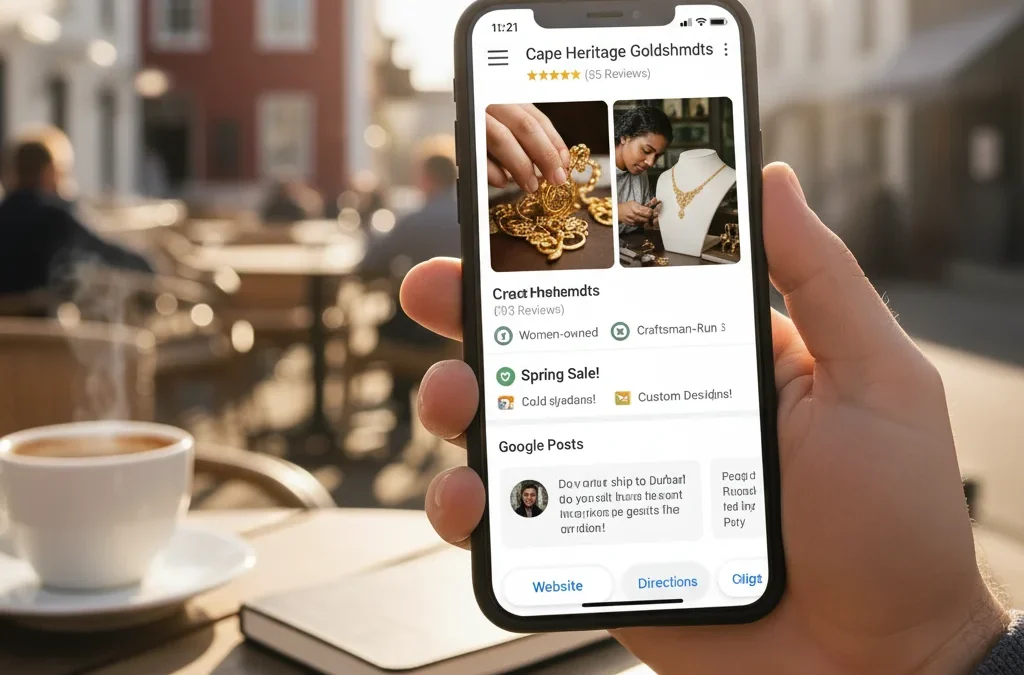
Your Google Business Profile (GBP) is the foundation of local SEO. When someone searches for "web design agency Johannesburg" or "digital marketing company near me," Google pulls information directly from GBP to decide who shows up in the Local Pack — that three-business block that sits above organic search results.
A half-finished profile is almost as bad as no profile at all. Here's what a fully optimised GBP looks like:
- Complete NAP details: Business name, address, and phone number — accurate and consistent.
- Business description with keywords: Write a genuine description that naturally includes your core services and location.
- Business category: Choose the most specific primary category, then add relevant secondary categories.
- Photos and videos: Profiles with photos receive significantly more direction requests and website clicks than those without.
- Regular posts and updates: Google's algorithm responds to active profiles. Post updates, offers, and news at least twice a month.
- Q&A section: Answer your own frequently asked questions before customers have to ask them.
Source: Whitespark, Ultimate Guide to Google Business Profile Optimization 2026
2. Get NAP Consistency Right Across Every Platform {#nap-consistency}
NAP stands for Name, Address, and Phone Number. The issue is simple: if your business details are inconsistent across your website, Google Business Profile, Facebook page, directories, and anywhere else you appear online, Google loses confidence in your listing.
Inconsistencies happen more often than people realise — a business moves premises, changes its phone number, or registers on a directory years later with slightly different details. Check your NAP across:
- Your website (footer and contact page)
- Google Business Profile
- Facebook Business Page
- LinkedIn Company Page
- Industry directories (Yellow Pages SA, Hotfrog SA, etc.)
- Your Google Search Console verified address
Run a quick audit. Fix any discrepancies. It's unglamorous work, but the ranking impact is real.
3. Build Review Velocity, Not Just Review Volume {#review-velocity}
Reviews are the third-largest ranking factor in Google's Local Pack, sitting behind only proximity and GBP completeness. Source: Watts Digital, Local SEO Reviews 2026 Playbook
87% of consumers read reviews before engaging with a local business. But here's what most businesses miss: Google cares about velocity — steady, consistent reviews over time — more than a single burst of 30 reviews followed by silence.
Practical ways to build review velocity in a South African context:
- WhatsApp follow-up: After a successful project or service, send a WhatsApp message with your direct Google review link. The response rate is far higher than email in South Africa.
- QR code at your premises: A printed QR code at reception or on your invoice that links directly to your review page removes all friction.
- Respond to every review: Responding to reviews — positive and negative — signals to Google that your profile is actively managed. It also shows potential customers who they're dealing with.
One important note: do not offer incentives for reviews. It violates Google's policy and risks your entire listing. Earn them honestly by delivering work worth reviewing.
4. Optimise Your Website for Location-Based Keywords {#location-keywords}
Your GBP and your website work together. Google cross-references both when deciding local rankings. Your website needs to clearly signal where you operate and who you serve.
This means:
- Title tags and meta descriptions: Include your city or region in key page titles. "Web Design Agency Johannesburg" beats "Web Design Agency" every time for local relevance.
- Header tags (H1, H2): Work your location naturally into page headers — not awkwardly forced, just present.
- Body content: Mention Johannesburg, Gauteng, or South Africa where it fits naturally. Write for the reader first, the algorithm second.
- Contact page: Include your full street address, embedded Google Map, and local phone number with the +27 country code.
- Schema markup: LocalBusiness structured data tells Google exactly what type of business you are, where you're located, and your operating hours. Most WordPress sites can add this via an SEO plugin like Yoast or Rank Math.
5. Create Location-Specific Service Pages {#location-pages}
If you serve clients across multiple areas — say, Johannesburg, Pretoria, and Centurion — a single generic page will not rank well for any of them. Dedicated location pages give Google clear, specific signals for each area.
A well-built location page includes:
- A unique headline targeting the specific area (not a carbon copy of another page)
- Local landmarks, neighbourhoods, or area-specific context that demonstrates genuine local knowledge
- Client testimonials or case studies from that location if available
- The area's specific NAP details
These pages take time to build properly, but they compound over time. Each one becomes an entry point for a specific local search query.
6. Build Local Citations and Directory Listings {#local-citations}
A citation is any online mention of your business's name, address, and phone number — even without a link. Citations from authoritative South African directories strengthen your local SEO signals.
Key local directories worth targeting:
- Google Business Profile (non-negotiable)
- Yellow Pages South Africa (yellosa.co.za)
- Hotfrog South Africa
- BusinessList South Africa
- Brabys
- Cylex South Africa
- Your industry-specific directories (legal directories, contractor directories, etc.)
The goal is consistent presence across directories that Google trusts as authoritative for the South African market. Source: BRBD Marketing, Local SEO for South African Businesses
7. Make Sure Your Site Is Fast and Mobile-Ready {#site-speed}
This one goes beyond local SEO — it affects all organic rankings — but it's worth flagging specifically in a local context. When someone finds your business through a local search on their phone and clicks through to your site, a slow or broken mobile experience kills the conversion.
Google's Core Web Vitals (Largest Contentful Paint, Cumulative Layout Shift, Interaction to Next Paint) are active ranking signals. A site that loads slowly on a 4G connection in South Africa is not just a bad user experience — it's an SEO liability.
Check your site speed using Google's PageSpeed Insights or Search Console's Core Web Vitals report. If your scores are in the red, the issue is almost always one of three things: unoptimised images, bloated plugins, or poor hosting.
The Bottom Line {#bottom-line}
Local SEO is not about gaming an algorithm. It's about making sure that when a customer in your area needs what you offer, your business shows up and gives them a reason to choose you.
The businesses that rank consistently in 2026 are the ones that treat their online presence as a long-term asset — keeping their profiles accurate, their sites fast, and their reputations active.
At Sarlie Digital, we've been helping South African businesses build and maintain that kind of presence since 2005. From technically optimised WordPress sites to full local SEO strategies, we focus on the work that drives real, measurable results — not vanity metrics. If you're ready to compete properly in local search, let's talk.